Saturday, April 23, 2022

Son of Stan(ley)

Wild speculation, just for fun

    I started the blog being in part inspired by the work of Jay Weidner who I was lucky enough to correspond with for a brief period. The impetus to build on his work was inspired by a memory of something Weidner said in a podcast interview. It dealt with the concepts from Eyes Wide Shut, that the character, Ziegler's name meant bricklayer or Mason in Yiddish and that the mansion used for the exterior of Somerton was the Rothschild mansion, Mentmore Towers. 'The Usual Suspects' Moment If you have ever seen the movie 'The Usual Suspects' (and if you haven't, what's wrong with you?), you'll recall a scene at the end (spoiler alert) where Agent Kujan, portrayed by Chazz Palminteri, has the realization that the story that he was told by Verbal Kint (portrayed by Kevin Spacey) is a complete fabrication.


(Courtesy Google images)

    Kujan begins to piece together random elements of Verbal's story and associate them with various items in the room where the interrogation takes place. Essentially, Verbal spins a narrative based on different elements of his environment including creating a character named from the manufacturer of  Kujan's coffee cup. Agent Kujan realizes all this in a beautifully edited scene of frenzied illumination.

   I take this detour to use another film to give the analogy of what I experienced as I listened to the podcast. It resonated with me for some time. Then it dawned on me. I had read a similar description, unrelated to EWS, years ago. "The Children's leader was further said to be a Mason, rank unknown..." "The abandoned church (site of rituals) in central Westchester... was immediately identified by Captain Gerry Buckholt... as the nearby 'burned out' mansion, which turned out to be the former Warburg-Rothschild estate." 

  These quotes are from pages 411 and 416 of the hardback edition of Ultimate Evil by Maury Terry. Many are now familiar with Terry's work after the Netflix documentary Sons of Sam. It did a very competent job of giving a high level overview of Maury's research revealing that the Son of Sam murders were perpetrated by others beside David Berkowitz. 

  Basically, Terry uncovered evidence of a Satanic cult operating in NYC and Westchester county which was headquartered in a mansion on Long Island, possibly run by a prominent doctor (Harford? Recall Kubrick's father was a homeopathic doctor). The cult sponsored the Son of Sam murders and even created snuff film videos from some of the murder scenes.

  I started to find synchronicities between Weidner's work, Kubrick's films and Maury Terry's work on the Son of Sam killings. Eventually I came to believe Kubrick may have had knowledge or even been part of a cult or 'the' cult on Long Island. 

  I recommend watching Weidner's first Kubrick's Odyssey film for context. The crux of Weidner's research is that The Shining is a movie that reveals Kubrick's complicity in faking the Apollo 11 film and photos. Note that Weidner never says that landings didn't take place, but that the film footage and photos we have are faked. The documentary Room 237 includes and interview with Weidner as well as a nice summation of his theory.

  The Shining or EWS have one multiple messages and meanings. I do believe in that matrix, they contain Kubrick's revelation of involvement in a Long Island cult that eventually caused him to escape the labyrinth and move to the UK.

  The opening sequence of The Shining shows Jack Torrance, having packed his family into a yellow VW, driving to the Overlook. Stephen King in hos novel has Torrance driving a red VW. In Kubrick's Odyssey 1,Weidner attributes the change to Kubrick asserting his dominance over King and letting him know that it is he, Stanley, telling the story. Possibly, probably.

  Maury Terry, in his research to the Son of Sam case, found out that there were witness reports of a yellow VW in connection to several of the Son of Sam shootings. Particularly the Donna Lauria and Stacy Moskowitz murders.

  Lawrence Klausner wrote a book, Son of Sam , subtitled as being 'Based on the Authorized Transcription of the Tapes, Official Documents, and Diaries of David Berkowitz".

I would like to quote an excerpt from page 227, emphasis mine;

OFFICER LOU MARCHINI was on patrol in the Bronx, operating out of the

43rd Precinct. He completed his tour at midnight and left the station house at

12:30 A.M. Going down the stairs in front of the building, he commented to

one of the sergeants, “Looks like a good night for a shooting. this Son of Sam

hasn’t struck in some time.” It was a morbid joke. In the back of his mind he

knew that his longtime friend, Officer Mike Speros, was suspected of being the

Son of Sam by other cops of their own precinct. the fact irritated both men,

perhaps Marchini more than his partner, for he knew the absurdity of it all.

Marchini made his statement, believing that Mike was still away in Cape

Cod on vacation with his family. “If anything were to happen this night,” says

Lou Marchini, “at least Mike would be nowhere near New York City.” Three

hours later, while watching an early-morning movie on television, Officer

Marchini’s hands went cold. A news flash broke across the screen telling of the

shooting. His premonition had come true.

POLICE OFFICER MIKE SPEROS had lived under extreme mental pressure for

months. Speros had seen other officers look at him with suspicion. they felt he

had all the characteristics of the killer as depicted by the police sketches. He

had been off duty when all the killings were done. He was left-handed. And

the fact that he was an artist didn’t help. the Son of Sam was supposedly

artistic. 

“I just couldn’t understand how the guys at work could believe I was the killer. they knew me—or at

least I thought they did,”says Speros. “I knew there was nothing I could do to change their minds. So I

hoped he would be caught while I was away.” But the Son of Sam was not.

Finally, a week before schedule, he decided to return. He packed his family

into his yellow VW bug, with its peculiarly ominous license plates GRK 44

(GRK stands for Greek), and drove back to his home in the Bronx.

 (Son of Sam, Simon & Schuster ebook edition)

  The movie Copycat tells the story of a serial killer who copies the modus operandi of the most infamous serial killers. Dr. Helen Hudson, portrayed by Sigourney Weaver and FBI agent M.J. Monahan played by Holly Hunter deduce he is following the order of serial killers listed in Dr. Hudson's book. When he goes to mimic Son of Sam, his victims are seated in a car (similar to SOS victims) and in the sideview mirror, the killer is seen as emerging from a yellow VW.

  Coincidence? Probably. If it's not, I would like to share this timeline of the yellow VW, in case anyone might think of Kubrick being influenced by a work in print.

Lawrence Klausner's Son of Sam - Published January 1, 1981

Maury Terry's Ultimate Evil - Published 1987

Copycat - Released October, 1995

Jay Weidner Kubrick's Odyssey 1 - April, 2011

The Shining - June 13, 1980

All wild speculation and just for fun.

Till next time.

Friday, May 5, 2017

There's nothing to this... The House of de Medici, a pictorial interlude

A Whimsical Interlude because there can't be anything to this... Right?

Kubrick's use of colors in EWS is stunning.

The use of Red:

Blue:

and Yellow:

are simply stunning.

I also enjoy the symbolism of the Fleur de Lis on blue wallpaper:

Google "Eyes Wide Shut" and Fleur de Lis

The Coat of Arms of the House of dei Medici: 

By ScolopendraJazz - Stemma dei Medici Stemma dei Medici Stemma dei Medici, CC BY-SA 4.0, https://commons.wikimedia.org/w/index.php?curid=47588168

The House of de Medici is a topic way beyond the scope of this blog and my humble abilities. Let us suffice to say they were among many other things, they were a great banking family, patrons of the Renaissance.

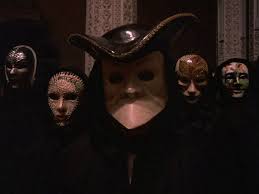
The masks in EWS were Venetian.


In addition to being a Beethoven opera and the Latin word for faithful, it was a journal for Lyndon LaRouche -http://www.schillerinstitute.org/fid_97-01/fidelio.html

A pdf of an article by Webster Tarpley on the Schiller Institute site is entitled "Venice's War against Western Civilization."

The opening paragraph states:

"The British royal family of today typifies the
Venetian Party, and continues the outlook and
methods of an oligarchical faction which can be
traced far back into the ancient world."

Dr. Bill meeting Nuala Windsor...

From Wikipedia:

"Over the next two decades, the Medici Bank opened branches in Rome, Geneva, Venice, and temporarily in Naples..."


Monday, February 13, 2017

Why would they fake the Moon landings anyway?

There are numerous opinions on why (if indeed they were) the Moon landings were faked.

"It was to bankrupt the Soviet Union" - yes, they many Soviet attempts to land a cosmonaut on the Moon bankrupted them... 20 years and a Cold War/Afghan War later.

"It was to get money for the military industrial complex" - Lord knows the Vietnam and Cold Wars weren't getting them any funds. Plus, great idea just to stop abruptly after Apollo 17 and never again leave Earth's orbit with a manned crew.

"It restored public confidence after the JFK, RFK, MLK, Malcolm X assassinations and took focus off Vietnam." - Maybe, but that was VERY high risk. If it was exposed on the heels of those national tragedies, I can't imagine how different we would be as a nation today

"The Nixon administration wanted to..." - Whatever

One of the other things that sticks in my craw is, if they were faked, why didn't the Soviets expose the hoax for all the world to see? Unless they derived some benefit as well, perhaps?

I was listening to Nexus magazine's Marcus Allen on Coast to Coast the other night where Mr. Allen was discussing his belief the landings were faked to bankrupt the USSR. I felt my old feelings of doubt regarding that assumption when something occurred to me.

We always regard the space program from a national perspective. But what if the architects of this are without national allegiances?

I view this through my Kubrick colored glasses with the EWS filter. What I'm positing is that IF the landings were faked, the ultimate goal was the effective control of the masses. The utter hoodwinking of a world's belief system. An ultimate experiment, if you will in manipulating mass consciousness.

I've said elsewhere in this blog (several times in fact, too lazy to go back and look for specific instances) that EWS was Kubrick's most autobiographical film. My personal feeling is that other  autobiographical films are The Shining and Barry Lyndon.

Others have gone into depth regarding The Shining, and I may attempt to share my personal observations regarding the Overlook, the Gold Room and a location that I think Kubrick is guiding us to... But let's talk about Barry Lyndon.

I know a lot of Kubrick fans who feel this is his least interesting movie, boring even. I think of it was the 1st movie in Kubrick's autobiographical cycle of work.

I once pointed out to Jay Weidner in an email correspondence that Lyndon reinforced his 'Kubrick faked the Moon landing' oeuvre. The protagonist, Lyndon is in love with his cousin, Nora Brady but the family wants her to marry British officer, John Quinn as it will enrich them financially and socially. To resolve the issue, a duel is staged between Quinn and Lyndon where the latter is led to believe he has killed Quinn and must flee to avoid the law. Lyndon leaves for the continent, never knowing that the whole thing was faked and so Quinn was free to wed Brady.

Lyndon goes on to ultimately wed a wealthy society widow by misrepresenting himself and ultimately falling out of high society.

The idea of a man who enters high society but does not ultimately belong, I believed referenced Kubrick and his associations built once he entered the film industry. I've also referenced elsewhere that the mask that Cruise/Harford wears to the Somerton orgy is a replica of ONeal/Lyndon's face.

One of ideas I came to entertain was the fact the Lyndon/Kubrick was hoodwinked at the beginning. What if, Kubrick DID fake the Moon landing photographs/video. What if Kubrick complied with the request, believing he was helping his country, enriching himself and his family, only to find out the truth later?

Why do I think this? Because, in addition to being autobiographical, I feel that the resonant theme of Kubrick's films from 2001 on is mind control.

The indoctrination of Alex in Clockwork Orange, the Monarch poster in The Shining (also the transformation of Jack Torrance) boot camp in Full Metal Jacket, the Rainbow references in EWS are some of the high level obvious examples. There are much more deeper and devious examples that require their own blog entry per film.

I think at some point Kubrick became aware that it was a big con, that the object was not to protect America or win the Cold War but to test controlling the populace. We believe what we're told.

Recall Capricorn One director, Peter Hyams comment: “There was one event of really enormous importance that had almost no witnesses. And the only verification we have . . . came from a TV camera.” - Wikipedia

Yet we believe what we were told, that we went there. If I have to convince you of the value of mass control and what it means to those who cast no shadows... then I can't help you.


Tuesday, December 27, 2016

Was Kubrick alerting us to Childhood's End?

 I've been working on a suggestion to view Eyes Wide Shut in other aspect ratios. I highly recommend it. If I can put it altogether, it will be the subject of my final blog entry.

There's a great site called Cryptokubrology that I also highly recommend. The author has done an amazing job of uncovering more mysteries, including the length of time between JFK and RFK's assassination is 237 weeks and the Kubrick - Ridley Scott connections.

Through Kubrick's collaboration with Arthur C. Clarke, the world was introduced to the concept of alien intervention in human history. Von Daniken's Chariot of the Gods and 2001 were released the same year, something the smacks of social engineering or conditioning to me. The original basis of 2001 was Clarke's short story, The Sentinel, written in  1948 as an entry to a BBC writing contest.

 My subject today is another work by Clarke, Childhood's End. Regarded by many as Clarke's best novel if not his best work overall.

Per Wikipedia:

"Several attempts to adapt the novel into a film or miniseries have been made with varying levels of success. Director Stanley Kubrick expressed interest in the 1960s, but collaborated with Clarke on 2001: A Space Odyssey (1968) instead.

"In the 1960s, director Stanley Kubrick was interested in making a film adaptation of the novel, but blacklisted director Abraham Polonsky had already optioned it. Instead, Kubrick collaborated with Clarke on adapting the short story "The Sentinel" into what eventually became 2001: A Space Odyssey (1968).[24] ]"

To poorly  summarize the complex plot,  mankind is visited by the alien race, the Overlords. The Overlords have come to help assimilate the human species with the Overmind, a collective intelligence of past ancient civilizations throughout the universe. In the end the assimilation fails and mankind is destroyed.

In the miniseries that was done in 2014, the Overlord Karellen, tells one of the protagonists regarding spaceflight: "The stars are not for man..."

This brings me to the work of John Brandeburg a plasma physicist who has researched Mars since the early Voyager pctures showed the 'Face' on Mars. I have read and highly recommend his book, Death on Mars: The Discovery of a Planetary Nuclear Massacre available on Amazon.

Again, to poorly summarize the  John's research:

super abundances of certain isotopes on the Martian surface are indicative of weapons signature from thermonuclear weapons. Before you say 'no way' be advised, Brandenburg has made presentations to the scientific community as well as the general public and published his work. To this date, no one has appeared to contradict his work. This is similar to the the issue of Boston College geologist, Robert Schoch insisting the Sphinx being eroded by water, i.e. rain. Though the Egyptology community vociferously denied this as it messed with their agreed upon timelines, no geologist would dispute Schoch's claims.

This is taken from the Secret Space Program conference website regarding Brandenburg's presentation:

Presentation Synopsis

John will show us evidence in support of an Earth-like Mars in the past, followed by presentation of nuclear data revealing ‘weapon-signature’ isotopes showing two massive nuclear “airbursts” in the Northern regions of Mars.

It will be shown that ‘anyone who can read a a map’ can see that both nuclear explosion sites are correlated to dump their resulting strongest shock-waves and fallout downwind on Cydonia mesa and Galaxias Chaos, two sites reported earlier as locations of possible archeology.

Review of recent imagery form the latest probes to Mars confirms the archeological nature of the objects seen there, with a massive carved face, a nearby massive pyramid, at Cydonia Mensa and another carved face and ruins at Galaxias Chaos.

This all paints a scenario of a planetary nuclear massacre, and also that the US government has been aware of this evidence since 1976. It also depicts a universe where their are intelligent forces hostile to primitive civilizations such as ourselves, and that human acquisition of advanced space flight technology is mandatory, not optional. We must sent astronauts to Mars with all possible speed, to maximize knowledge of what happened there. This is the best way to avoid sharing Mars fate.


John's contention is there was a nascent civilization on Mars, on par with the Mayans or Egyptians  that was wiped out by someone. He relates it to Fermi's Paradox which states that life and civilization should be the norm in the universe but where is the noise of the other civilizations.

What does this have to do with Kubrick in general and EWS in particular.

As I stated above, Kubrick used science fiction to introduce the public to the concept of alien intervention. It was not in Kubrick's nature to revisit a concept using the same venue. The war movies, Paths of Glory, Barry Lyndon and Full Metal Jacket used wars from different eras (WW I, Seven Years War and Vietnam).

I feel there was a way of introducing the concept of Childhood's End finale in what I consider the most autobiographical of Kubrick's films.

As I have related in other posts, there are many autobiographical references in Kubrick's films including EWS. One I've been toying with lately is that Nick Nightingale, Dr. Bill Harford and Mr. Ziegler are all aspects of Kubrick.

Nick represents the Jazz musician Kubrick wanted to be, Dr. Harford represents the medical professional his father wanted him to be. Ziegler? This was a character not in the sourcework, Traumnovelle. It was invented by Kubrick and played by Sydney Pollack, a formidable director in his own right. Also, it is generally accepted by most conspiracy related researchers that the name Ziegler is intentional.

From the Illuminati Watcher website:

“Ziegler” is a German surname meaning ‘brick-maker’. There is also a Jewish University in Los Angeles that ordains Rabbis under this same title. Some theorists believe this is a tie to Freemasonry and the Kabbalah, which the checkered floor and surname support."

While I do not debate this, I would like to propose that maybe Ziegler is a pun, 'brick-maker' referring to Ku-brick. Brick maker could be Kubrick's father who tries to entice him into something (orgy group) and is possessor of certain knowledge. As Ziegler tells Bill:

"Bill, do you have any idea how much trouble you got yourself into last night just by going over there? Who do you think those people were? Those were not just some ordinary people. If I told you their names... no, I'm not going to tell you their names... but if I did, I don't think you'd sleep so well at night. "

Regarding not sleeping at night:

"Be careful what you wish for (re:alien life). If you guys knew even a fraction of the shit we do, you will never sleep again. I promise you that" - Paul Hertz Director of the astrophysics division at NASA

So to come back to the relation to EWS. Our best science tells us that something exterminated life on Mars.

The upshot of Childhood's End is we were found wanting and exterminated.

And finally as the orgy scene unfolds in EWS, Jocelyn Pook's soundtrack originally contained a recitation from the Bhagavad Gita. It was later removed after protests from Hindus. 

It stated:

“Whenever there is a decline of Dharma and the rise of Adharma,O Arjun, then I Shree Krishna manifest (or incarnate) Myself. I incarnate from time to time for protecting the good, for transforming the wicked, and for establishing Dharma”

Maybe Kubrick is saying we're due for an avatar. According to Hindus the next Avatar is Kalki, harbinger of the end time.

Friday, August 5, 2016

 All That Jazz


 It's Season 2 now, so it's ok to reference Mr. Robot right?


So in last season's finale, as Elliot is walking through Evil Corps headquarters after the encryption package has been released, the soundtrack is playing a there's a synthesized version of Dmitri Shostakovitch's Waltz No. 2.

It's the perfect mood music for a surreal moment. However, for me it will always evoke the opening moments of Eyes Wide Shut.

Kubrick's music choices for his films is a book in itself (Listening to Stanley Kubrick: The Music in His Films – by Christine Lee Gengaro) and there are several ways to interpret the choices for EWS. There's a definite Stalin era vibe with Shostakovitch and György Ligeti in the mix but it's the jazz element that catches my attention here and the economic collapse element in Mr. Robot that jarred my memory.

First, I'm not a musician, I only know what I've heard over time about Jazz being all about the notes you don't play as much as it is about the notes you do play. I have no idea what that means. But I know Kubrick was a Jazz enthusiast. So I think sometimes it's about what Kubrick leaves out.


Take for instance Mr. Harford's wild ride in EWS. When he hits roadblocks, Bill whips out his wallet.
Whether it's dealing with Domino, Mr. Millich or the itinerant cab driver, Bill is able to smooth things out and get his way by throwing money at the issue.

The big exception is at Somerton and after. Once he gets into trouble there, there's no more money fixes.

Reference to a world where cash is meaningless? To a level of our society that does not use cash for transactions?

Or presaging a time when money will be valueless? (In truth it already is, it only has inherent value because we believe it has inherent value.)

Does Kubrick try to be predictive? Probably not.

The other big note not played involves the scenery. Now recall all of the controversy around the set. The movie is set in New York city in the present time (1998-1999). We know it was filmed entirely in the UK. There were complaints about the streets being to wide for NYC, not enough foot traffic, etc.


The skyline shots as well as the shots from the bridge as Harford heads down 495, are all stock footage.

But one thing you never see in EWS and would easily create the atmosphere that one is in NYC, are the Twin Towers. They are NOWHERE to be seen in EWS. Not too big a deal? Maybe not. But check out any movie or TV show, set in NYC in that time frame (1998-1999) that DOESN'T show the towers at some point, and you'll have me convinced.

Maybe not predictive. Maybe just raising awareness.

Till next time


Tuesday, August 2, 2016

What does it all MEAN?

I'm right, Weidner's wrong (tongue in cheek)

I said at the beginning that as an artist, at some level Kubrick wants you to put your interpretation on his work. "Well, what do YOU think it means?" kind of thing.

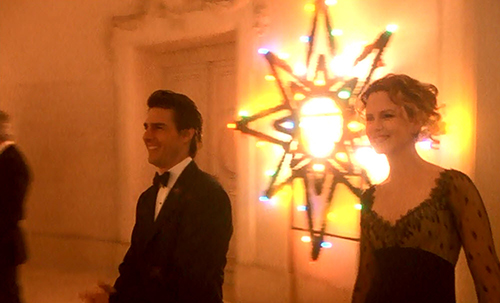
I have an email string with Jay Weidner regarding the star symbol at Ziegler's Christmas Party in EWS.


Basically I was trying to convince him that the star wreath was a replica of Ishtar's star because it was eight pointed.  He was emphatic that it represented Venus and that it referred to Nicole Kidman's character as a symbolic Isis goddess.

I share below:


"Images off of the cross at Hendyae.  Please note the eight pointed star and the sun.  Kidman is Isis.  She has been chosen as the new female icon of the cult.  She is the missing person in the eleven girl circle at the orgy.  Something huge was cut from EWS.  It has to do with the star."

The Hendaye reference is from a brilliant book by Weidner and his co-author Vincent Bridges

The Mysteries of the Great Cross of Hendaye: Alchemy and the End of Time

 This image and text is from the website Vigilant Citizen


The star at Zeigler’s house is nearly identical to the ancient symbol of the star of Ishtar."
nowing Kubrick’s attention to detail, the inclusion of the star of Ishtar in this party is not an accident. Ishtar is the Babylonian goddess of fertility, love, war and, mostly, sexuality. Her cult involved sacred prostitution and ritual acts – two elements we clearly see later in the movie.
“Babylonians gave Ishtar offerings of food and drink on Saturday. They then joined in ritual acts of lovemaking, which in turn invoked Ishtar’s favor on the region and its people to promote continued health and fruitfulness.”
– Goddess Ishtar, Anita Revel
Ishtar herself was considered to be the “courtesan of the gods” and had many lovers. While inspired in bed, she was also cruel to the men that got attached to her. These concepts will constantly reappear in the movie, especially with Alice.
During the party, Bill and Alice go their separate ways and are both faced with temptation. Alice meets a man named Sandor Szavost who asks her about Ovid’s Art of Love. This series of books, written during the times of Ancient Rome, was essentially a “How to Cheat on Your Partner” guide, and was popular with the elite of the time. The first book opens with an invocation to Venus – the planet esoterically associated with lust. Interestingly enough, Ishtar (and her equivalents in other Semetic cultures) was considered to be the personification of Venus.

I share this to point out that both can be right, the trick is not to put too much emphasis on one interpretation. We can be too dogmatic. That being said, I do believe there are overarching themes that carry through all of Kubrick's films and that he meant for EWS to be his magnum opus. It was to at once celebrate the Cryptocracy and expose them as well.

UPDATE: I just watched the documentary Room 237 for the umpteenth time last night. I really enjoy it because I feel, to a degree, everyone quoted in the film is right. The Shining does make reference to the Native American holocaust as well as the Holocaust and to wild speculation about Apollo 11.
I personally feel that a lot of effort goes into pointing out there are a lot of  references to the number 42 and the luggage at the Overlook. What intrigues me is no one makes the connection that in 1942, Kubrick was 14 and his family moved to a new apartment (Source : Stanley Kubrick: A Biography By Vincent LoBruttobo, pg 10).
He was roughly the same age as Herman Raucher, the main character in the movie 'Summer of 42', the movie playing in the scene were Danny and Wendy are watching TV (that has no electrical cable). It's made note of the fact that regarding Room 237, that 2x3x7 = 42. So in '42 Kubrick moved into a new room.

Tuesday, November 10, 2015

Viddy well my brothers... Viddy well - More Peels from the MK-Orange

  A Clockwork Ultra


  On the surface, PWS (pre-wild speculation) A Clockwork Orange is a film masterpiece based on the book by Anthony Burgess about a youth culture violence in a near future society. The main character, Alex DeLarge leads a violent gang that rapes and beats it's way through life until he's caught, entered in an experimental rehabilitation project. In the British version of the book, there is a final chapter where Alex eventually matures enough to regret his violent, lawless youth.
   I once found a discussion board which attempted to answer what was the meaning of the film. I recall the Kubrick was mentioned only in passing while the majority of focus was on the book. Much speculation was around Burgess searching for meaning after he and his wife were assaulted in a home invasion.


I don't know if that is true. I should also mention I haven't read the book.

   Now, I will commence with the wild speculation, utilizing the works of Kubrick, Miles Mathis and Adam Gorightly. All inaccuracies and conclusions are mine, and I refer you to works of these individuals on their own merit, not on my interpretation. I'm obviously not in their league as researchers or writers.

Also, here's link to a great article regarding the book and film by Theodore Dalrymple:

http://www.city-journal.org/html/16_1_oh_to_be.html

The Act, the Masks, the 'Shadows in the Mirror' 

McDowell stated "If Kubrick hadn't been a film director he'd have been a General Chief of Staff of the US Forces. No matter what it is—even if it's a question of buying a shampoo it goes through him. He just likes total control." 
Filming took place between September 1970 and April 1971, making A Clockwork Orange the quickest film shoot in his career. - Wikipedia  (emphasis mine)


Examples of Eyes Wide ...


My speculation begins with the correlation of the film with the Manson Family murders.


Miles Mathis regarding Paul Tate:

"In 1959, the Tates moved to (Cafe?- FN)Verona, Italy, where Paul Tate was stationed at Passalacqua, the headquarters for SETAF (Southern European Task Force). This links him to Operation Gladio. General Maletti—commander of Italian military intelligence at the time of the Tate murders—later testified in court that the CIA had been involved in many false flag operations in Italy and Europe, including murders and bombings, “for the purpose of creating an Italian nationalism that was capable of halting what it saw as a slide to the left.” Sound familiar? Maletti added, “Don't forget that Nixon was in charge and Nixon was a strange man, a very intelligent politician but a man of rather unorthodox initiatives.” Nixon was in charge in 1969, but Operation Gladio had been instituted by Allen Dulles much earlier, and it was financed in large part by the US, through the CIA, which Dulles led under Eisenhower and Kennedy (1953 to late 1961). The Operation kicked into high gear in the late 50's to counter growing “leftist” movements, especially in Italy. We must assume that is why Paul Tate was in Verona in 1959 with his family. Paul Tate was not just military, he was a colonel in intelligence, which indicates he was probably involved in Gladio."

Manson 69 - 70 CWO - 71

Sharon Tate and Slim Pickens:


Viddy Well, My Brothers - A short piece about Clockwork Ultra

Peeling an MK- Orange


   Let me state now that I believe that the primary theme of Clockwork Orange is mind control.

   Allow me to quote from an interview with Kubrick regarding CO:

"The central idea of the film has to do with the question of free-will. Do we lose our humanity if we are deprived of the choice between good and evil? Do we become, as the title suggests, A Clockwork Orange? Recent experiments in conditioning and mind control on volunteer prisoners in America have taken this question out of the realm of science-fiction." 


   The similarities with MKULTRA (The documented CIA excursion into mind control) are ramapant.
The CIA pushed forward with MKULTRA with the idea that they were trying to keep up with Soviet and Chinese research demonstrated on POWs in the Korean War.


   Now, while I was researching the Clockwork Orange and Manson connections,


Michel Ciment: In your films the State is worse than the criminals but the scientists are worse than the State.
Kubrick: I wouldn't put it that way. Modern science seems to be very dangerous because it has given us the power to destroy ourselves before we know how to handle it. On the other hand, it is foolish to blame science for its discoveries, and in any case, we cannot control science. Who would do it, anyway? Politicians are certainly not qualified to make the necessary technical decisions. Prior to the first atomic bomb tests at Los Alamos, a small group of physicists working on the project argued against the test because they thought there was a possibility that the detonation of the bomb might cause a chain reaction which would destroy the entire planet. But the majority of the physicists disagreed with them and recommended that the test be carried out. The decision to ignore this dire warning and proceed with the test was made by political and military minds who could certainly not understand the physics involved in either side of the argument. One would have thought that if even a minority of the physicians thought the test might destroy the Earth no sane men would decide to carry it out. The fact that the Earth is still here doesn't alter the mind-boggling decision which was made at that time.

 
It's just my interpretation but it's just seems that Kubrick says one thing but means another. 'No sane man'? Was it the politicians that pushed to have the Hadron Collider move forward? I mean, after all, "...it is foolish to blame science for its discoveries..."

Then there's this piece that really snapped my head. Responding to a question about the level of violence in the film, Kubrick says:

"It is absolutely essential that Alex is seen to be guilty of a terrible violence against society, so that when he is eventually transformed by the State into a harmless zombie you can reach a meaningful conclusion about the relative rights and wrongs. If we did not see Alex first as a brutal and merciless thug it would be too easy to agree that the State is involved in a worse evil in depriving him of his freedom to choose between good and evil. It must be clear that it is wrong to turn even unforgivably vicious criminals into vegetables, otherwise the story would fall into the same logical trap as did the old, anti-lynching Hollywood westerns which always nullified their theme by lynching an innocent person. Of course no one will disagree that you shouldn't lynch an innocent person -- but will they agree that it's just as bad to lynch a guilty person, perhaps even someone guilty of a horrible crime? And so it is with conditioning Alex."

I feel like I'm hearing two very different things here. One is, that it was necessary to show the horrible things Alex does, in order to balance what the state does to him. If your goal is to show, "It must be clear that it is wrong to turn even unforgivably vicious criminals into vegetables..." then why do you need to make it difficult to see the State is '...involved in a worse evil...?" Am I missing something?

I also feel that Kubrick's answer is a powerful statement against mind control and the manipulation of public opinion, no matter what the motivation behind it. In the beginning of the interview with Ciment, he states,

 Is this what Kubrick referred to as a decision made by politicians? 

The shadow that MKULTRA casts is larger than many realize. 

So my point is, was Kubrick speaking from the viewpoint of a guilty conscience? Or as a possible victim or witness to other victims?


Tuesday, June 16, 2015

For the Moon is hollow, and I have touched the sky...

This will put the 'wild' into 'wild speculation' for this blog. Please suspend your disbelief for a few moments.

   What if JFK was ultimately assassinated because of the Apollo program? If anyone read the King Kill post, you are vaguely familiar with the work of James Shelby Downard and his theory of the Grand Masonic Conspiracy.
   Just to recap some salient points for this blog:

   The actual assassination was carried out by a cabal, including but not limited to:
  • Rogue elements of the CIA and Military Industrial Complex
  • Elements of international organized crime
  • Anti-Castro Cubans
   These groups worked for their mutual benefit but there was a higher organizing principle which I doubt they even perceived. At the heart of the operation was a ritual oriented group who planned the assassination at a strategic level. This included having the regicide take place close to the 33rd Parallel and other assorted details to meet their needs.
   To what end? To ultimately control the 'dreaming mind' or what Jung would term the collective unconscious of man. Wild stuff indeed. What I'm adding to the mix is, that the final trigger, so to speak (RAW, you are missed) was the fact that the cabal wanted to profit from a space race and go so far as faking a Moon landing but knew JFK wouldn't go for it.
   So the plan to rake in billions for NASA, which the intelligence community, military industrial complex and others would get the lions share of, was in place. There was just one fly in the ointment.


   Whereas if Tricky Dick had won the election, he would have not only committed U.S. forces to the Bay of Pigs, he would be much more amiable to a fake Moon landing (which, if you believe it was faked, took place on his watch in '69).
   So the Intelligence community and Mafia were in it for self preservation, the military industrial complex to start the Viet Nam war and clean up on government NASA contracts, the Anti-Castro... well you get the picture. But the Organizing Principle (OP) was in it to preserve the lie of the Moon race.
   Let's be clear, the Organizing Principle is not American, or limited to any nationality. To wit, Kennedy called for space cooperation with Khrushchev and the Soviet Union, not a race and there exists a memo to the effect that NASA was to start working toward that. Within less than a year both leaders were gone.
   I now raise the stakes. What if the cabal never intended to go to the Moon? I give you the works of Christopher Knight and Alan Butler as well as Louis Proud. 
   Both books deal with lunar anomalies with Proud's book dipping into some of the more esoteric theories including Gurdjieff's statement that humanity is food for the Moon.
   What if the goal of NASA was just to build rockets, wow the public and collect money? Then the political rhetoric of the cold war  turned it into the Moon race which the OP knows can't happen. Why? Because there's stuff going on there that we can't know about. Whether it's the Moon is artificial and houses our alien overlords or is a life form which harvests our souls, they never intended to really go there. Along comes Kennedy with his guarantee and now they must act. So now they pay attention to their complaining constituents in the cabal and say 'Boys, have we got a ritual for you... I mean, yeah, let's get rid of the bum."
   Just really, REALLY wild speculation. Let's get even wilder. What if Bobby and JFK Jr heard rumors of the real motivations for the hit?

 What does all this have to do with Kubrick? Well, if you follow the 'Kubrick faked the Moon landings" meme, that part is obvious.
   Is it possible Kubrick was aware of Kennedy's fate? Recall there was a deleted scene from Dr. Strangelove where there's a pie fight in the bunker. At one point Peter Sellers as President Muffley gets a pie to the face.

 The line that follows, "“Gentlemen...our beloved president has been infamously struck down by a pie in the prime of his life! ”


   Also, if you subscribe to my theory that he got a peek at the OP and wanted to tell someone,then you have this final tidbit. Memorializing previous events is one thing. Prediction is another.
   Kubrick died on March 7, 1999. He specified that EWS had to be released on July 16, 1999. As many have pointed out, it was the 30th anniversary of Apollo 11 landing on the Moon. That's probably the reason. However, maybe he wanted to draw attention to an event that had not occurred yet.

July 16, 1999 was the date that John Jr's plane disappeared.

Till we meet again.

Wednesday, June 10, 2015

When the Going Gets Weird, the Weird turn Pro...

   I love wild speculation. I also love speculation that has the slightest glimmer of the possibility of being true.
  One example is the many occult students and writers who follow the path blazed by Kenneth Grant regarding my favorite writer H.P. Lovecraft. Namely that Lovecraft was not just a fiction writer but an occultist who was either consciously or unconsciously revealing occult truths in his work.
Grant speculates where Crowley was trained and immersed in Ritual Magick and secret societies, Lovecraft was a 'natural' or unconscious occultist. Or he may have even been in contact with a group but kept that hidden.
   All of Lovecraft's known voluminous correspondences and journal entries bespeak of his strictly materialist views and his disdain for spiritualism (ala Houdini) and Theosophy. However this hasn't  prevented any number of authors and bloggers from speculating that Grant was right. This mostly consists of examining the lives of Aleister Crowley and Lovecraft to see if their paths crossed. (They had the potential when both were in New York City for a brief time in the 20s). Or if they were just aware of the others work. (Lovecraft may have been aware of Crowley, as he was aware of Theosophy, no evidence Crowley knew about Lovecraft's work.)
  Many others have written their own grimoires based on Chaos Magick workings with the Great Old Ones (Lovecraft's creations). To be fair, some of those are written from the point of view that Lovecraft was a materialist but that the fervent following of his creations has established them as egregores, capable of action in the material world.
   The ones who feel there's more to Lovecraft and his creations than meets the eye includes the aforementioned Grant, Empire of the Wheel author Walter Bosely and the prolific Peter Levenda, who may or not be the author behind the nom de plume 'Simon' author of the 'real' Necronomicon.
By way of explanation, the Necronomicon is fictional grimoire created by Lovecraft.
   Anyway, I'd like to quote from Levenda's excellent work, 'The Dark Lord':
"In 'The Call of Cthulhu' Lovecraft reveals that the rituals required to summon the Great Old Ones involve orgies by people who are of mixed races ... This conflation of unbridled sexuality and exotic races and ethnicities is a common theme in colonialist literature and was a feature in the castigation of the practice of Tantra in India by the British colonizers."
  Why mention this? Well does anyone recall this scene in EWS?
Ok, now the initial scene involved synthesized music being played over an Orthodox Romanian rite played backwards. Once the orgy starts, Harford walks through the mansion to Indian music. The original scene called for a quotation from the Bhagavad Gita read in Hindi, that was later removed due to complaints from the Indian community.
   Also, we all know that the Somerton Mansion where the orgy takes place was shot in the old Rothschild Mansion, Mentmore Towers, right? Well, half right. The exterior was Mentmore Towers, the interior was Elveden Hall. To quote the Wikipedia entry for Elveden (http://en.wikipedia.org/wiki/Elveden_Hall): 


"In 1849, the Maharajah Duleep Singh, ruler of the Sikh Empire and owner of the famous Koh-i-noor diamond was exiled to England, having been removed from his kingdom by the British East India Company.
The Maharajah purchased the 17,000-acre (69 km2) Elveden Estate in 1863 and set about rebuilding the country house and dressing it in an Italian style. However, he redesigned the interior to resemble the Mughal palaces that he had been accustomed to in his childhood. (emphasis mine)
Elveden Hall played host to a wide range of sporting activities but none rivalled the Maharajah's passion for shooting. His shooting parties were popular amongst aristocracy including Prince George, Duke of Cambridge."

Bizarre Tantric orgiastic rites filmed in a mansion that was used to housing parties of the elite? So was Kubrick a Lovecraft fan and believer? No. I'm not suggesting that, only that they arrived at a similar place by different routes. I believe, whether it is Satanic or Saturnian (as Weidner suggests, my suspicion is it's closer to Tantric) that Kubrick's Somerton group was in it for more than kinky kicks. I  believe they were 'feeding' something, invoking something... that would break through when the stars are right, as Lovecraft would say. That is one of my beliefs about the hidden meaning in Kubrick's films.  To summarize:

A. There is a hidden elite that the general public was not aware of in Kubrick's day. (They've at least heard about it now in the digital age)

B. That one of their goals is the emergence Artificial Intelligance

C. That this elite is in league with or serves another, non-human intelligence.

More on this later. Especially in regards to the Bear symbolism. Hint, like all of Kubrick's symbols is multi-layered. There's more to it than just Cold War symbolism.

Tuesday, March 17, 2015

Space Odyssey 2.0 - Brief post with a film recommendation

 
The study of Kubrick leads one to branch out and examine the works of other directors. I find the works of Ridley Scott and Christopher Nolan to be especially interesting.

Nolan's Dark Knight series is arguably the best of the 'superhero' genre and there are many Kubrickian references in these films. Prime example, the use of the Rothschild estate, Mentmore, as the setting for Wayne Manor. But nothing prepared me for the complete homage that Interstellar is to Kubrick's masterpiece, 2001 A Space Odyssey.

I will only highlight some of the references as I highly recommend watching the movie on it's own merits and seeing for yourself.

SPOILER ALERT: If you have not seen the movie, watch it first because there are definitely spoilers to follow.

In no particular order:
  • The scene where Matt McConaughey goes to a meeting with his daughters teacher who insists the Moon landings were faked, not as a theory but this is being taught as history.
  • The infamous bookshelf, in one of the close ups, we see a copy of Stephen King's The Stand. An apocalyptic movie with an apocalyptic book from the author who gave us The Shining.
  •  The soundtrack, at peak dramatic moments, the held final organ note is reminiscent of Also Sprach Zarathustra from 2001.
  •  The wormhole detected by NASA orbits Saturn, in the original Arthur C Clarke story for 2001, the monolith sent it's signal to Saturn, not Jupiter.
  • The wormhole was placed there to help humanity, the monolith was sent to evolve humanity.
  • The journey through the wormhole is eerily reminiscent of Keir Dullea's journey to Jovian monolith.
  •  The scene where McCoanughey loses his ship and is floating in space mirrors the final scene of 2001 with the cosmic fetus.
  •  In 2001 they have the AI computer HAL, in Interstellar there's the AI computer/robot TARS.
  • Whereas HAL had an order and agenda which almost killed the main character, the Matt Damon character has a similar agenda.
This is by no means exhaustive, there are many more. I will possibly spend another post focusing on one or two that I have not included here. I do believe Christopher is aware of many of Kubrick's themes and possibly understands the overall message concealed in Eyes Wide Shut.

Till we talk again.


Wednesday, October 29, 2014

Why Doesn't Anyone mention Capricorn One?

    So let's say you view Jay Weidner's 1st installment of Kubrick's Odyssey. You are then acquainted with the idea that Kubrick faked the Moon Landings for NASA.
   Now, you happen upon the Youtube video, The Shining Code, which reinforces and elaborates on the clues Kubrick supposedly left in his 1980 film The Shining.
   So now armed you might move onto Room 237 or some other documentary that presents similar information.

So listen to this film maker regarding Apollo 11:

“There was one event of really enormous importance that had almost no witnesses. And the only verification we have . . . came from a TV camera.” link

He goes on to say,  "Whenever there was something on the news about a space shuttle, they would cut to a studio in St. Louis where there was a simulation of what was going on. I grew up in the generation where my parents basically believed if it was in the newspaper it was true. That turned out to be bullshit. My generation was brought up to believe television was true, and that was bullshit too. So I was watching these simulations and I wondered what would happen if someone faked a whole story." link

 The film maker is Peter Hyams, who wrote and directed Capricorn One.
 Capricorn One is a fictional account of a faked Mars landing that was done without the complicity of the astronauts (one of whom was O.J. Simpson). The reason for the hoodwinking was to prevent funding from being cutoff from the space program.  The astronauts are briefed at the last minute and are forced to comply to save their families. One of the astronauts transmits a coded message to his wife during an in flight TV chat. What could be more relevant to a discussion of coded messages about a faked lunar landing?

I recommend the movie. Highly.

   So my question becomes, why doesn't Jay Weidner or anyone else pushing the Kubrick Apollo theory mention Peter Hyams and this film? Their critics certainly do, with the gist being that they probably thought it was a documentary.

   What's more, Peter Hyams had contact with Kubrick. In fact he wrote and directed the sequel to 2001 A Space Odyssety, entitled 2010 The Year We Make Contact.


From Wikipedia:

When Clarke published his novel 2010: Odyssey Two in 1982, he telephoned Stanley Kubrick, and jokingly said, "Your job is to stop anybody [from] making it [into a movie] so I won't be bothered."
... However, Peter Hyams was interested and contacted both Clarke and Kubrick for their blessings:

    'I had a long conversation with Stanley and told him what was going on. If it met with his approval, I would do the film; and if it didn't, I wouldn't. I certainly would not have thought of doing the film if I had not gotten the blessing of Kubrick. He's one of my idols; simply one of the greatest talents that's ever walked the Earth. He more or less said, 'Sure. Go do it. I don't care.' And another time he said, 'Don't be afraid. Just go do your own movie.'

Again, what could be more relevant to the Kubrick/Apollo discussion? Why leave it out, because it taints the theory and makes it seem a derivative of the film? I think a strong argument could be made that it strengthens the theory and adds to the drive to disseminate the truth.

Till later, hope all is well.


Wednesday, July 2, 2014

Some ramblings or Herr Ziegler, there are Seven Days in May

   OK, I know no one reads this. Most people get here by accident. I've lost a lot of the drive to build to the final conclusion I've reached and reveal what I think was the inspiration for 'Somerton'.


  But here I am, damning all grammatical guidelines and pressing on. Why? Only God and Satan know the answer.

  I feel some pain when I hear or see the work of others where something I uncovered or shared is revealed as that individuals own work.

  So for that reason, I'm going to reveal some personal conclusions, speculative of course. Anyone who tells you 'This is what Kubrick REALLY meant" doesn't know anymore than you or I do. He played it close to the vest. Don't believe it? Read "Eyes Wide Open" by Frederic Raphael. 


   I'm obsessed with Eyes Wide Shut because it's like one of those stereoscopic pictures. I can't figure it out yet but if I cross my eyes enough I'll get the image in the background. And not unlike Michael Corleone, every time I walk away...

Jan Harlan, Kubrick's brother-in-law and executive producer, reported that Kubrick was "very happy" with the film and considered it to be his "greatest contribution to the art of cinema".
-http://en.wikipedia.org/wiki/Eyes_Wide_Shut-


  Sometime, when you are bored, Google this question:

"What do the colors red blue and gold symbolize in medieval art?"

 You might see this:

Answer:
It symbolizes a heroic act performed by a lowly member of the royal court during times of inter-kingdom feuds.

  Remember the 'mock sacrifice' in EWS?

Or was the sacrifice Kubrick's?

Let's go with some WILD speculation.

First, what we know:

  • In 1942 our young film maker moves to a new home/apartment. His father wants him to follow him in medicine. Stanley prefers jazz (loves the drums). His father buys him his first camera to get him interested in something to compensate for his lagging schoolwork.
  • He has his breakthrough film 'Paths of Glory' made with the help of Kirk Douglas and his Byrna Production group. It's filmed in Germany, where Kubrick meets his 3rd and final wife, Christiane who is an extra in the film. She is niece of German director Veit Harlan. 
  • His first blockbuster and huge commercial success is Spartacus, again with the assistance of Kirk Douglas.
  • Douglas and he argue on set. Douglas in his book on the making of Spartacus tells the story of confronting Kubrick on horseback and intimidating him. He berated him in front of the entire cast and crew about not changing his clothes and shooting battle scenes. Douglas recalls in his mind, he thought people were cheering. I'm not quite sure they saw it as heroic as Kirk did. 

 I've always felt 1942 and the Kirk Douglas collaboration are two huge turning points in Kubrick's life. So much so that he felt the need to mirror both in scenes in The Shining and Eyes Wide Shut.


The Shining -  the 'moving in' scene in the Overlook with it's Summer of 42 references. (The movie Summer of 42 is playing on a TV set)
Jack Nicholson's character is named Jack. Also the name of Kubrick's father.

Eyes Wide Shut - Bill Harford and Nick Nightingale represent two sides of Kubrick. Harford is a doctor (like Kubrick's father) and Nightingale is a medical school drop out who becomes a jazz musician (Stanley didn't follow in his father's footsteps and loved jazz, wanting to be a musician.)

My big reveal. I think the Victor Ziegler character represents Kirk Douglas. 

The Ziegler character brings Harford into a world he doesn't normally interact with socially or professionally. His wife asks him if he knows anyone at the party and he answers "Not a one."

This could mirror Douglas introducing Kubrick into the studio system from which he was an outsider, previously making documentaries and small budget independent films.

Ziegler makes subtle overtures to bring Harford (and perhaps his young wife) into they're 'circle'. Maybe this mirrors something Douglas did or maybe it is just mirrored into Douglas view of what Kubrick should be doing as a director (i.e. playing ball with the producer, studio, etc)

Harford goes a little nuts in infiltrating the Somerton club and ends up in trouble. Ziegler confronts him and basically gets him to drop it.

Refer to the Spartacus dust up mentioned earlier and outlined in Douglas' book "I Am Spartacus".

Now Kubrick could be mirroring the public confrontation but the one in EWS is private. And Spartacus was made in '60, EWS in '99. It seems like a long time to get that off your chest. Perhaps Stanley felt his health failing and new this would be his last film. Or maybe he knew it was his last for other reasons.

Maybe it was something that Kirk introduced him to that he never got over and his last wish was to point a finger.

What? you say. What connection did Kirk Douglas have with Eyes Wide Shut? In the appendix to 'I Am Spartacus" Douglas tells the tale of trying to work out his differences with Kubrick. He invited Stanley to a session with his therapist. At the end of the session, Kirk's therapist tells Stanley, "Hey, you know what would make a good movie? Arthur Schnitzler's Traumnovelle."


Wednesday, August 21, 2013

Kubrick and King Kill 33 Degrees

A Slight Detour

"In expressing the laws of the unity of endless diversity a symbol itself possesses an endless number of aspects from which it can be examined and it demands from the man approaching it the ability to see simultaneously from different points of view. Symbols which are transposed into the words of ordinary language become rigid - then, they grow dim and very easily become 'their own opposites' confining the meaning within the narrow dogmatic frames, without giving it even the very relative freedom of a logical examination of a subject. "

Gurdjieff, speaking in 'In Search of the Miraculous' by P.D. Ouspensky

   Don't be fooled by the sub heading, we are still dealing with Kubrick and EWS. It's just a slight detour before I go into the relationship between Kubrick and the Sumerian stele from the previous post.

   This post was inspired by a radio interview of the author Robert Sullivan regarding his book, 'The Royal Arch of Enoch'. It struck me that Sullivan along with other Masonic writers such as Christopher Knight and Robert Lomas are following the symbolic path to lead to a conclusion that is then reinforced by circumstantial evidence.
   I have no problem with this approach, it's what I'm doing here with the exception I don't believe there is a hard and fast answer. You're combining someone who is trying to convey a message, Kubrick, who also happens to be an artist. As Gurdjieff said, we must not become rigid and dogmatic as we transpose these symbols into ordinary language. And as I will post later, there is much evidence of Masonic symbolism in Kubrick's films.
   But the point I wanted to cover is that there is a group, if you will, that takes symbols very, very seriously. Such that, as many consider mathematics a universal language, this group considers symbols to be that language. They believe symbols to be a means of communicating through time, across cultures and even species. Symbols are not just visual, they are ritual. They are acted out.
  

This nattily attired gentleman is the late James Shelby Downard, co-author of a brilliant essay entitled "King Kill 33". It became the inspiration for the Marilyn Manson song of the same name.
   I do not espouse the political views or philosophies of Downard or his co-author Michael Hoffman II but that doesn't lessen the brilliance of this essay. I recommend obtaining a copy, unless you are lucky enough to have a 1st edition Apocalypse Culture, edited by Adam Parfrey. Subsequent editions did not have it.
   Downard and Hoffman are proponents of the concept of 'Masonic Sorcery' and it's practice by Arch Criminals.  I will do my best to summarize but there is sufficient information available on the web.  
   Basically, the authors describe a 1% of Masonry ("...most 'Freemasons' apparently have no idea of the evil that is part of Masonry...") who are in on the secret and that the key of Masonic Sorcery is the rulership of the collective  mind (dreaming mind or unconscious mind) of humanity.
   This 1% uses symbolic ritual (psychodramas, they call them) enacted out on the world stage to achieve their ends. The elite have already enacted two of their three alchemical rituals. The first was the destruction of the prima materia at a point close to the 33rd degree, Los Alamos, with the detonation of the 1st modern atomic bomb. The second was the Killing of the King with JFK. The 3rd is to 'Make Manifest all that is Hidden'.

    To quote the Jim Brandon in 'Weird America' via Wikipedia,


"Would you believe John F. Kennedy as a ceremonial king-who-must-die? I'm afraid there is a certain body of opinion, undoubtedly the farthest-out brain wave of assassinology yet, that maintains the killing was pulled off, not by the Russians, the Cubans, the CIA, or the Mafia, but by alchemists. As I understand the hypothesis, President Kennedy was for some reason chosen as The King (remember "Camelot," "Macbird" and all that?) after the fashion of James G. Frazer and Mary Renault whose "The King Must Die" he had been given to read before his death.

This killing of the king in Dallas was related somehow to the touching off of the world's first atomic bomb at the Trinity Site in New Mexico 18 years earlier. Apparently the Bomb was the "destruction of primordial matter" stage of the grand alchemical working, but these conspiracy buffs aren't much more specific on details than were the early alchemists in their recipes. Anyway, Kennedy represented the next stage of the process - the "Death of the White King" - when he was immolated on a trinity site of his own. For, aren't Dealey Plaza and the ill-famed Triple Underpass on the bank of the old Trinity River?"

 A large part of this process is the revelation of the method, to fulfill the 3rd Law of Alchemy to "make manifest all that is hidden". According to Downard, this is done to "...seal finally and for all time the eternal pagan psychodrama which works through every mass organization of man."
   To this end, Kennedy (the representation of the king) was killed in Dallas (as close the 33rd degree latitude as possible) as a scapegoat to bring the 1% closer to their avowed goal of rebuilding Solomon's Temple on the 33rd degree. Essentially ritual and symbol are so much a part of this 1% that most of us who think linearly and literally can not comprehend their purpose.
   You would have to read the entire essay, I'm not doing it justice and Downard and Hoffman believe what they are writing.


What does that have to do with Kubrick or EWS? I don't know...  an elite group, committed to ritual and symbolism... hmm?


For Barry Lyndon, for the sake of the widow's son.


Notice the resemblance?


Tuesday, August 6, 2013

Dotting the I's - Part Deux

Yo Saturnalia!

   Ok, it's been awhile. Lots of new information has come up. Some of it confirming suspicions, much of pointing toward new avenues.

   Suffice it to say, this post will complete some of the thoughts of the previous post but not in the way I had originally intended. Mostly because of new information but also because when traveling in the speculative kingdom of Kubrickistan, one is not served well by adhering to dogmatic beliefs.

   I have struggled with the Venice EWS dynamic. There's the masks, the Verona Restaurant (Verona having been part of the Venetian Republic).

 My original plan was to focus on how Venice taught the world in general and Britain in particular how to attempt rule the world covertly through finance and economic infiltration. 
   I wanted to focus on the  theories of Larouche, the Venetian bankers and Venice as a Kubrickian symbol for British Banking, the Black Nobility, etc. But if Columbo has taught us nothing else, it's that there's always one more thing.
   That thing is the movie is set at Christmas.


To Follow Arthur or Not to Follow Arthur

   One can go the whole antinomian route and say they were going for a Satanic reference, sacrificing Mandy in a reversal of the Christian birth and yet...
   The easiest thing to do that would confirm the whole Venetian angle would be to follow the Schnitzler source material and have the movie set at Carnival time. I again refer to Frederic Raphael's memoir, 'Eyes Wide Open'. He mentions his frustration with updating the story from 19th century Vienna to modern day New York and several times reaching an impasse with how to handle an issue. Kubrick would occasionally give the advice, "Follow Arthur". Yet it's the ways in which Kubrick  doesn't follow Arthur that we have to look. He doesn't follow Arthur in using the Venetian masks. (It's a masked ball in 'Traumnovelle' yes, but they are not specified as Venetian Carnival masks) and he certainly doesn't follow Arthur with the Christmas setting.
   Critics have mentioned the association between Venetian masks and lascivious activities. It has also been stated that the Christmas setting allowed Kubrick some interesting lighting choices and to make a statement on consumerism impact on the modern couple. I think it's more than that.

Vigilant Citizen to the rescue

    There's a fantastic two piece article on the Vigilant Citizen website regarding EWS. I want to reference something in part II but I highly recommend the entire piece as well as the overall site.

http://vigilantcitizen.com/moviesandtv/the-hidden-and-not-so-hidden-messages-in-stanley-kubricks-eyes-wide-shut-pt-ii/

The writer makes mention of the shooting location of the Somerton orgy being a Rothschild mansion and that "...has been documented that the Rothschilds do actually partake in masked events very similar to those shown in Eyes Wide Shut. Here are rare images taken from a 1972 party given by Marie-Hélène de Rothschild."

 It's not so much the image that got me as the text under the image on the page, which read,
"Baroness Marie-Hélène de Rothschild and Baron Alexis de Redé at a 1972 party. Invitations were printed in reversed writing. One wonders if this party “degenerated” into something resembling what is shown in Eyes Wide Shut."
    What I'm focusing on here is the invitations were printed in reversed writing. That made me think of Saturnalia.

 Ailanrutas!

   One of the major characteristics of this ancient Roman festival was reversal. From Wikipedia:
"Saturnalia is the best-known of several festivals in the Greco-Roman world characterized by role reversals and behavioral license. Slaves were treated to a banquet of the kind usually enjoyed by their masters. Ancient sources differ on the circumstances: some suggest that master and slave dined together..." http://en.wikipedia.org/wiki/Saturnalia
   So the behavioral license fits in, what else? Well, I include the fact that it was a Greco-Roman feast, and was celebrated in the Greek style (meaning how the sacrifices were made, as well as the public banquets). I have received unconfirmed intel that those who cast no shadow, at least some of them, are in to the Greek myths big time. Whether this pertains to the ancient Greek Mystery Religions or actual worship of the Olympian deities, I don't know.
    Also, again quoting the Wikipedians, "The Saturnalia reflects the contradictory nature of the deity Saturn himself: "there are joyful and utopian aspects of careless well-being side by side with disquieting elements of threat and danger"". That would fit exactly what transpires at Somerton in the film. Also mentioned in the article, "...he (Saturn) gathered together the unruly race of fauns and nymphs scattered over mountain heights, and gave them laws … . Under his reign were the golden ages men tell of: in such perfect peace he ruled the nations." And lastly, "His contradictions... indicate Saturn's capacity for obliterating social distinctions."

   Both the laws for the unruly 'races' and obliterating social distinctions sound like some of the goals of they who cast no shadows.

   Just for reference, the common celebration cry was Io Saturnalia! Which allowing for Latin I and Y sounds would be pronounced Yo Saturnalia!

   Is that all? Jay Weidner mentions, I believe in a Red Ice Radio interview that the script from Arthur C Clarke originally called for the Monolith to be from Saturn not Jupiter. Also, in Troy McLachlan's excellent book "The Saturn Death Cult" he postulates the Kubrick was attempting to expose the Saturn Death Cult, whose members recall a Golden Age when Saturn was the center of the Solar System (Saturn ruled in Roman terms) but was later usurped by the Sun.
    Could there be anything else? Perhaps, regarding this image:


But more on that later.